The modern agricultural landscape demands containment systems that balance absolute security with operational flexibility, and 16 livestock panels represent a strategic investment in this balance. By utilizing heavy-wall steel and engineered joining mechanisms, these panels provide a robust barrier that minimizes animal stress while maximizing the handler's ability to manage livestock efficiently.
From a global perspective, the transition toward modular containment like 16 livestock panels is driven by the need for rapid deployment and scalable infrastructure. Whether for permanent boundary security or temporary zoning, the ability to quickly configure high-strength pens is essential for maintaining livestock health and preventing costly escapes in diverse farming environments.
Understanding the technical specifications—from rail configurations to pipe profiles—allows farm managers to optimize their investment. The implementation of 16 livestock panels ensures that safety standards are met through protective top caps and industrial-grade locking systems, effectively reducing injury risks for both the animals and the agricultural staff.

The Engineering Standards of 16 Livestock Panels
The structural integrity of 16 livestock panels is rooted in the use of premium heavy-wall steel. This material choice is not arbitrary; it is specifically engineered to withstand the immense lateral pressure exerted by livestock during sorting or containment, ensuring that the panels do not warp or buckle under heavy load.
Furthermore, the precision of the welding and the adherence to metallurgy standards ensure that every joint remains rigid. By offering both round and oval pipe profiles, these panels allow farmers to choose between classic structural strength and specialized rigidity, tailored to the specific behavioral patterns of their livestock.
Versatility in Global Agricultural Layouts
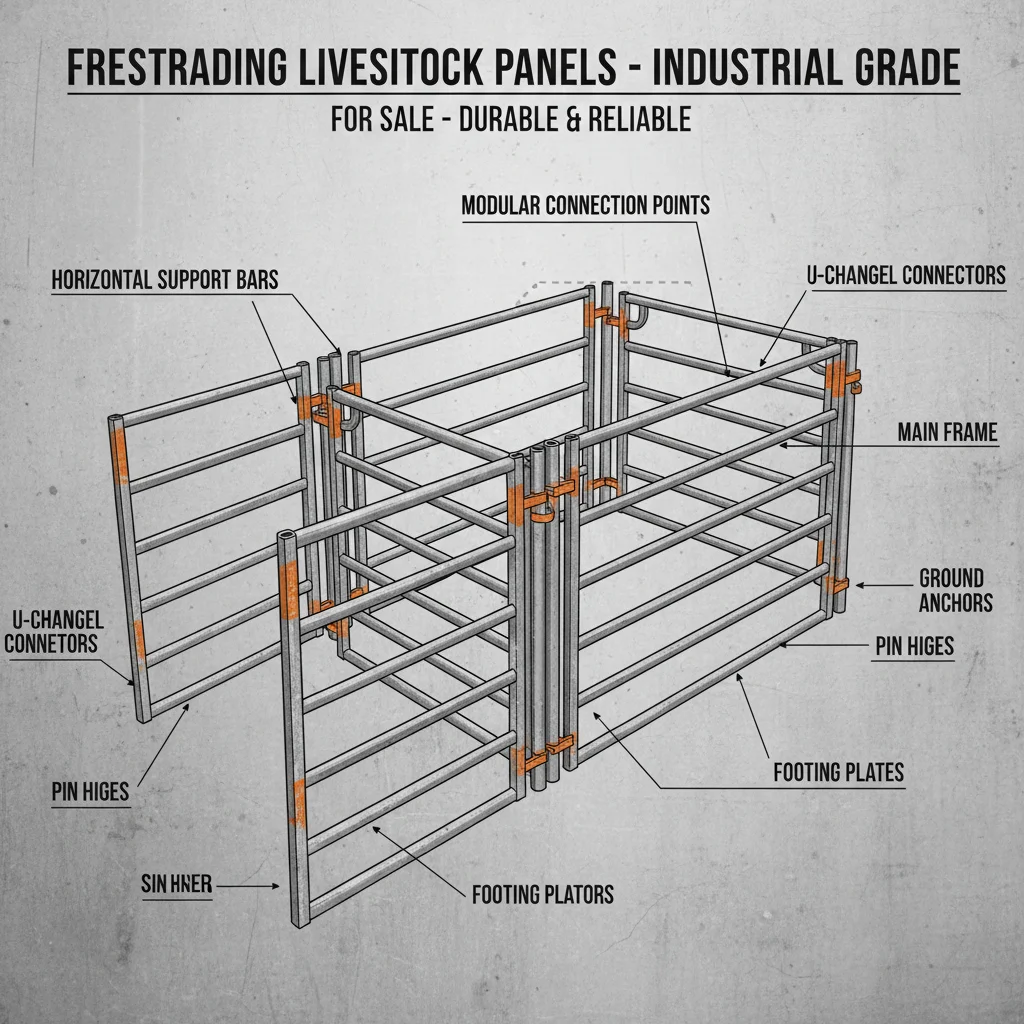
In the global agricultural sector, the ability to adapt containment areas is a critical operational advantage. 16 livestock panels cater to this need by offering three distinct deployment modes: permanent, semi-permanent, and fully portable. This flexibility allows a single investment to serve multiple purposes, from fixed boundary security to temporary weaning pens.
Portable options are particularly valuable in large-scale pasture management, where pens must be shifted frequently to prevent overgrazing and manage animal rotation. The modular design ensures that these panels can be reconfigured without the need for specialized tools, significantly reducing the labor hours required for farm reconfiguration.
Whether integrated into a concrete-in post system for permanent borders or utilized as bolt-on frames for semi-permanent zoning, these panels adapt to various terrains and requirements. This versatility ensures that farm managers can optimize their space utilization while maintaining a secure environment for their herd.
Core Components for Maximum Security
The security of 16 livestock panels relies heavily on the precision of their connection hardware. Utilizing industrial-grade joining pins and bolts, the system creates a gap-free connection that eliminates the possibility of animal escape, which is a common failure point in lower-quality fencing.
A key technical feature of 16 livestock panels is the integration of heavy-duty gates. These gates are constructed from the same heavy-wall steel as the panels and feature standard chain catches, ensuring that entry and exit points are as secure as the boundary walls themselves.
Beyond the structural frames, the available heights of 1m and 1.2m, combined with 5-rail or 6-rail configurations, ensure that the panels are matched to the specific size and strength of the livestock. This tailored approach prevents animals from jumping over or pushing through the barriers.
Performance Metrics and Durability Analysis
When comparing modular systems to traditional fencing, the performance of 16 livestock panels stands out in terms of installation speed and lifespan. Traditional fencing often requires labor-intensive digging and setting, whereas the modular nature of these panels allows for rapid deployment and immediate operational use.
The use of rust-resistant finishes ensures that these panels can withstand the harsh outdoor conditions of agricultural environments, including moisture and UV exposure. This durability translates directly into a longer service life and a lower total cost of ownership over time.
Durability and Efficiency Ratings of 16 Livestock Panels
Animal Welfare and Safety Integration
Animal safety is not an afterthought but a core engineering principle in the design of 16 livestock panels. The inclusion of integrated protective top caps is a critical safety feature, as it eliminates sharp edges that could cause lacerations to livestock or handlers during movement and sorting.
By reducing the risk of injury, these panels contribute to a lower-stress environment for the animals, which is directly linked to better health outcomes and higher livestock productivity. The smooth finish of the heavy-wall steel prevents snagging, ensuring that livestock can be moved safely within the pens.
Long-Term Operational Value and ROI
Investing in 16 livestock panels provides a significant return on investment through the reduction of maintenance costs. Because the system uses standardized hardware and high-strength materials, the need for frequent repairs is minimized compared to traditional wood or light-gauge wire fencing.
The modular design also ensures that if a single component is damaged, it can be replaced individually without needing to dismantle the entire containment system. This minimizes downtime and ensures that livestock security is never compromised during maintenance cycles.
Furthermore, the adaptability of the panels allows them to evolve with the farm. As livestock numbers grow or management strategies change, the panels can be expanded or repositioned, protecting the initial capital expenditure by providing long-term utility across different farm phases.
Installation Methods and Maintenance Strategies
The installation of 16 livestock panels is designed for efficiency. For permanent installations, concrete-in post settings provide an immovable anchor, while bolt-on frames offer a robust yet removable alternative for semi-permanent needs. This dual-approach ensures that the containment system matches the intended duration of the livestock area.
Maintenance is simplified through the use of standardized joining pins and bolts. These hardware systems allow for quick adjustments and repairs without the need for specialized welding equipment on-site, enabling farm staff to maintain the integrity of the barriers with basic tools.
To ensure maximum longevity, we recommend periodic inspections of the locking pins and the application of rust-preventative touch-ups in areas of high wear. By following these simple maintenance guidelines, the structural integrity of the panels remains intact even under the most intense livestock pressure.
Core Specifications and Comparison of Livestock Panel Configurations
| Configuration Type |
Structural Component |
Installation Method |
Security Level |
| Permanent Panel |
Heavy-wall Steel / 6-Rail |
Concrete-in Post |
Maximum |
| Semi-Permanent |
Round Pipe / 5-Rail |
Bolt-on Frame |
High |
| Portable Pen |
Oval Pipe / 5-Rail |
Joining Pins |
Moderate-High |
| Heavy Duty Gate |
Steel Frame / Chain Catch |
Hinge Mounting |
Maximum |
| Standard Boundary |
Round Pipe / 6-Rail |
Mixed (Concrete/Bolt) |
High |
| Small Livestock Zone |
Oval Pipe / 5-Rail |
Joining Pins |
High |
FAQS
Portable panels are engineered for temporary pens and can be moved easily without tools, making them ideal for rotating livestock across pastures. Permanent panels, conversely, are typically bolted or concreted into place to provide long-term boundary security and withstand higher continuous pressure.
Yes, we provide multiple height options (1m and 1.2m) and rail configurations (5 or 6 rails). This allows farm managers to select the specific containment height and gap spacing that best matches the size and jumping ability of their specific livestock breed.
The panels utilize a specialized system of industrial-grade joining pins and bolts. These components lock the panels together tightly, eliminating gaps and preventing the fence line from shifting or opening when animals lean or push against the barrier.
All our sheep and livestock gate frames are manufactured from heavy-wall steel. This ensures the gates remain square and functional even with frequent daily use, preventing the sagging or bending common in lighter-weight steel alternatives.
Both offer high durability. Round pipes are the industry standard for classic strength and ease of cleaning. Oval pipes can provide different structural rigidity and animal contact profiles, often preferred in specific livestock handling scenarios to better guide animals.
Every panel is meticulously crafted with integrated protective top caps. These caps eliminate all sharp edges at the top of the rails, significantly reducing the risk of skin lacerations for livestock and improving safety for handlers working around the pens.
Conclusion
The implementation of 16 livestock panels represents a comprehensive approach to modern farm management, combining heavy-wall steel durability with modular flexibility. By focusing on critical safety features like protective top caps and secure joining mechanisms, these panels solve the dual challenge of livestock security and animal welfare.
As the agricultural industry continues to evolve toward more efficient and sustainable practices, investing in high-quality, adaptable containment systems becomes essential. We recommend that farm managers evaluate their specific rail and height requirements to maximize the operational lifespan and ROI of their infrastructure. Visit our website for more information: www.haotianmesh.com